
Four decades after the revolution and a few months before the Iranian 11th parliamentary elections, IranPoll and The Chicago Council on Global Affairs have conducted a joint coordinated study of both Iranian and American public opinion on key national and international issues.
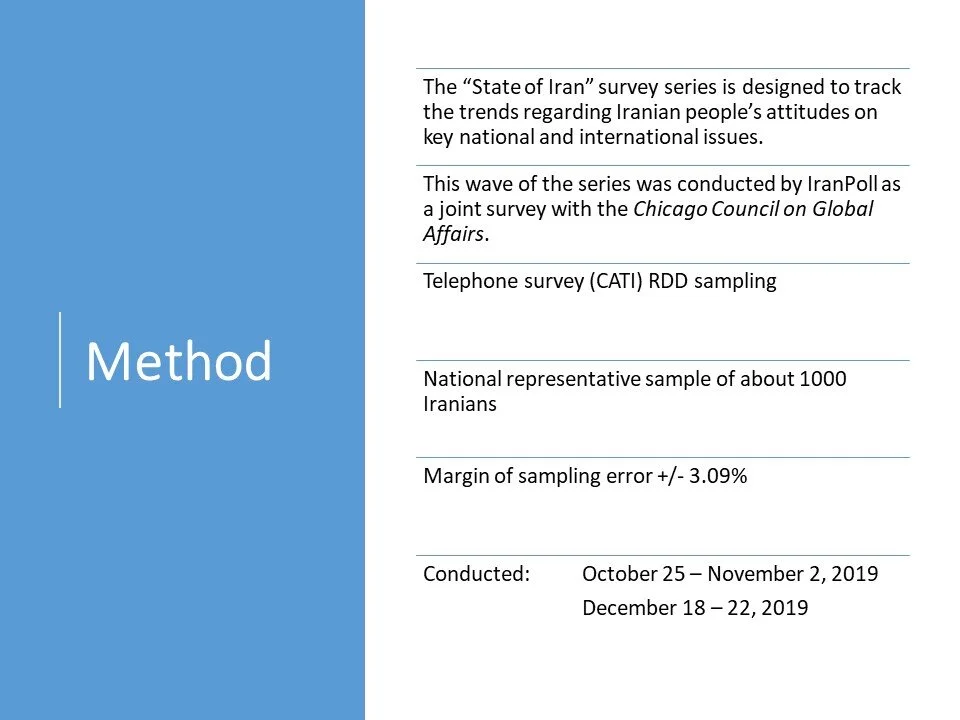
The Iranian part of the study was conducted as a part of IranPoll’s ‘State of Iran Survey Series’ utilizing our standard nationally representative sampling across two waves. First wave was conducted from October 25 to November 2, 2019 through telephone interviews from 1,000 Iranians. Second wave was collected during December 18-22, 2019 through telephone interviews of 1,007 Iranians. The sampling margin of error was +/- 3.09% for each wave. The US part of the study was conducted January 10 to 12, 2020, by Ipsos among a weighted national sample of 1,019 adults 18 or older living in all 50 US states and the District of Columbia.
The findings of the Iranian study show that large majorities of Iranians say the economy is bad (73%) and is getting worse (56%). While most Iranians say domestic mismanagement and corruption (56%) is having a more negative impact on Iran's economy than sanctions (39%), three in four assert that the sanctions are having at least some negative impact on Iran's economy and the living condition of ordinary Iranians.
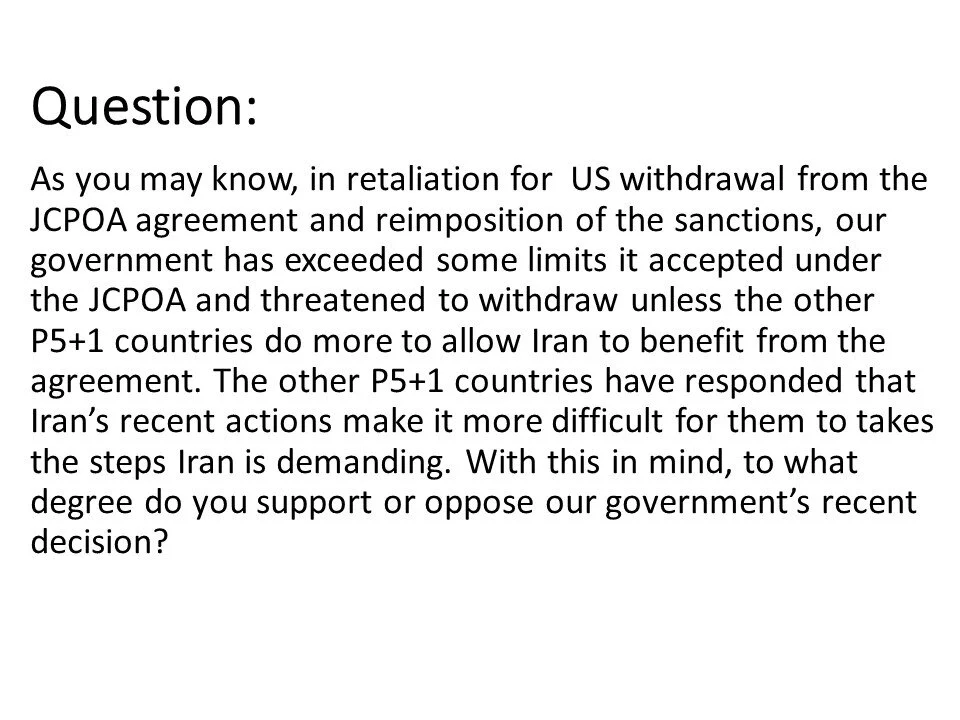
Despite poor economic conditions and the perceived negative impact of sanctions, 7 in 10 Iranians would reject a deal that would require Iran to forego its nuclear enrichment in return for sanctions relief. Moreover, 3 in 4 Iranians say they approve of their government's decision to exceed some limits Iran accepted under the JCPOA and to threaten withdrawal from the JCPOA unless the other P5+1 countries do more to allow Iran to benefit from the agreement.
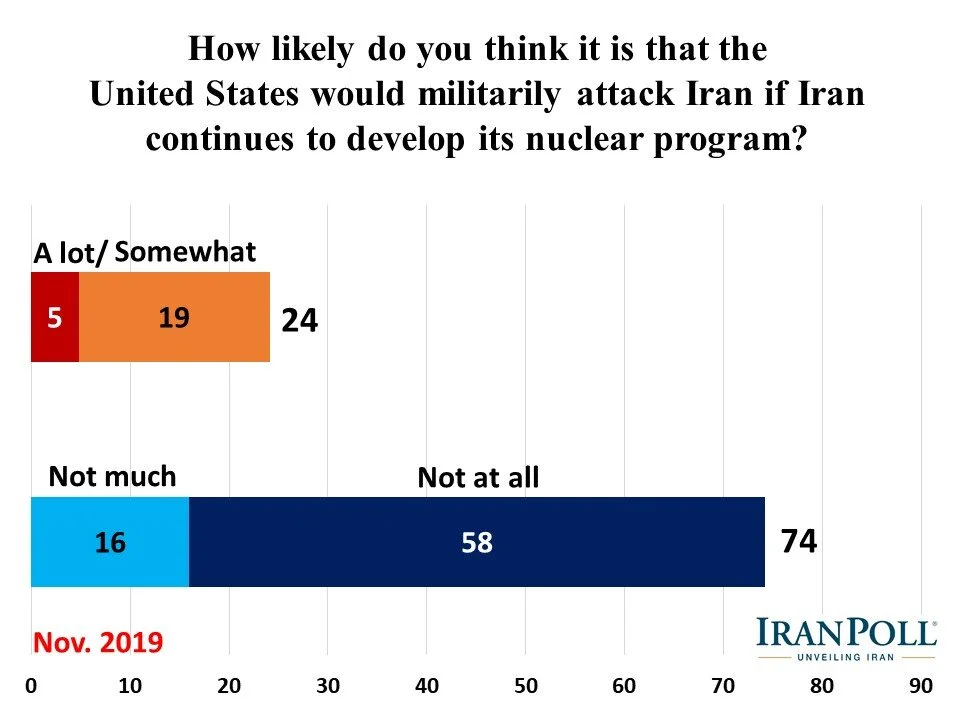
After exploring some potential reasons for why sanctions have not been able to persuade Iranians to accept US demands, the study - which was conducted before the targeting of General Qasem Soleimani - shows that majorities of Iranians did not think that the United States would take military action against Iran if Iran continues to develop its nuclear program (74%) but say if Iran is attacked, it should militarily retaliate against the US (59%).
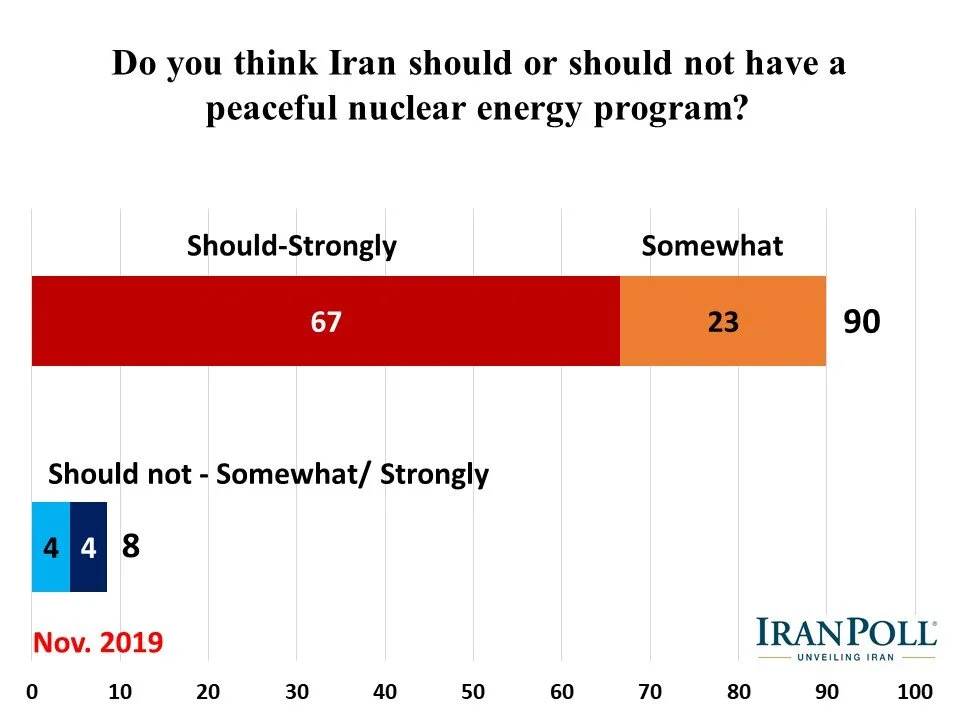
There are, however, some good news in the study. First and foremost, most Iranians say Iran should not develop nuclear weapons (59%) and think that development of nuclear weapons is against the teachings of Islam (66%). Secondly, Iranians say they would support talks between Iran and the United States if the United Stated would return to the JCPOA and keep their side of that bargain.
MAIN FINDINGS:
Below please find the results of this survey in greater detail:
A report jointly written by Dina Smeltz - Senior Fellow at the Public Opinion and Foreign Policy program of the Chicago Council on Global Affairs - and Amir Farmanesh - CEO of People Analytics (IranPoll) - on the results of the surveys has been published by the Chicago Council and is available here.
The frequency tables of the survey results conducted in Iran are available here for the first wave and here for the second wave.
The results of the survey conducted in the United States are available here.
The PowerPoint slides highlighting some of the survey results based on a presentation made by Dr. Amir Farmanesh CEO of People Analytics (IranPoll) are available here.
The results of the first wave were presented by Dr. Farmanesh at The Chicago Council on Global Affairs. This presentation was covered by the C-SPAN network as detailed here.
Some of the results from the second wave were utilized by the Munich Security Conference in its 2020 report.